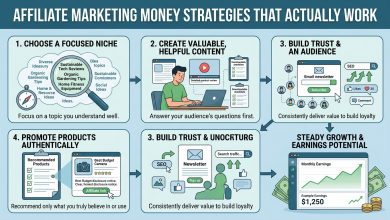
7 Proven Affiliate Marketing Strategies for Higher Conversions and Better Results
Table of Contents
Affiliate marketing, a performance-based marketing model, continues to be a highly lucrative channel for businesses and individuals alike, with estimated spending projected to reach $8.2 billion by 2022 and sustained growth into 2025 and beyond. However, simply driving traffic to affiliate links is no longer sufficient; the true measure of success lies in converting that traffic into tangible actions, such as sales, leads, or sign-ups. In an increasingly competitive digital landscape, affiliate marketing strategies must evolve to prioritize conversion optimization, ensuring every click has the highest potential to translate into revenue. This comprehensive guide delves into advanced techniques and current best practices designed to elevate conversion rates, fostering sustainable growth and maximizing profitability for affiliate marketers.
Understanding Your Audience and Niche Selection
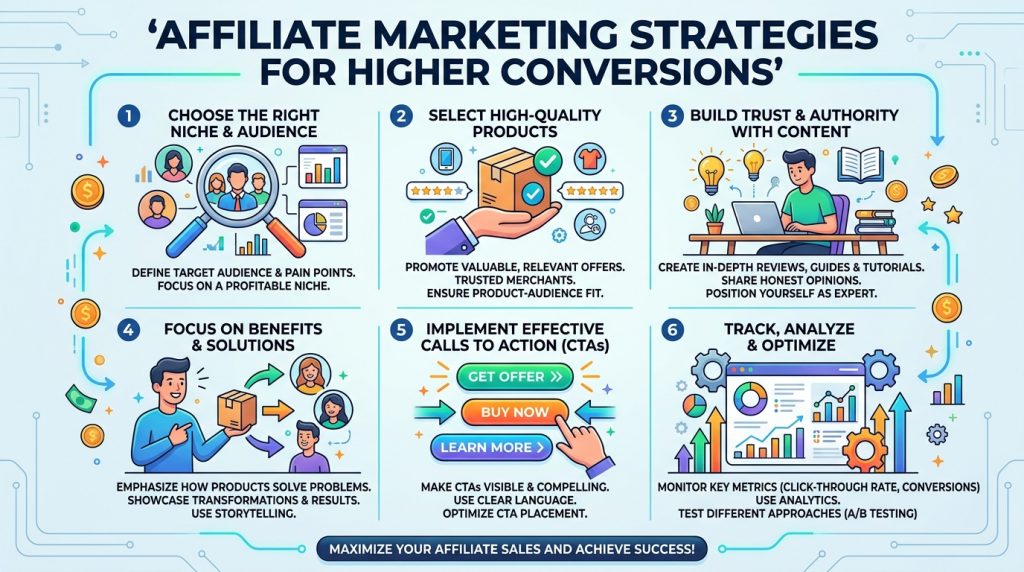
The bedrock of any high-converting affiliate marketing strategy is a deep understanding of your target audience and a precisely chosen niche. Without this fundamental insight, even the most sophisticated marketing tactics can fall flat. Identifying your ideal customer involves asking critical questions: Who are they? What are their interests, pain points, and online behaviors? Understanding these aspects allows you to align your content and product recommendations with their genuine needs, making your promotions feel authentic and valuable rather than like a hard sell.
Niche selection is equally crucial. A focused niche allows you to become an authority, building credibility and trust with a specific segment of the market. Instead of broadly promoting various products, concentrate on a specific area where you can offer genuine expertise and curate highly relevant offerings. This also helps in targeting long-tail keywords with commercial intent, attracting users who are actively seeking solutions and are closer to making a purchase decision. For example, promoting a fitness app can be paired with a list of beginner workout ideas, offering value beyond just a sales pitch.
- Audience Research: Utilize tools like Google Analytics to understand demographics, interests, and behavior patterns of your current visitors.
- Problem-Solution Alignment: Identify specific problems your audience faces and position affiliate products as effective solutions.
- Niche Authority: Focus on becoming a go-to resource in your chosen niche by providing in-depth, valuable content.
Crafting High-Converting Content: Beyond Basic Reviews
Content is undeniably king in affiliate marketing, but not all content is created equal when it comes to conversions. To truly drive sales, your content must be valuable, authentic, and strategically optimized. People are looking for honest assessments, including both the strengths and limitations of products, as transparency builds trust.
Diversifying content formats is also a powerful strategy. While product reviews are popular, comparison guides, how-to tutorials, resource pages, buying guides, and informational videos can capture different segments of your audience throughout their buyer journey. Videos, in particular, can keep users engaged longer and often convert better than text-based content alone.
Key content creation principles for higher conversions include:
- Helpfulness First: Prioritize solving problems and answering questions for your audience. Affiliate links should enhance the content, not dictate it.
- Authenticity: Share honest reviews, including pros and cons, to build credibility.
- Personal Experience: Whenever possible, include firsthand testing insights and real-world usage scenarios to demonstrate product value. This also helps your content stand out and avoids being flagged as generic.
- Storytelling: Weave products into stories that resonate with your audience, solving problems or answering real questions.
- Visuals: Incorporate captivating visuals, motion images, or videos to grab attention and explain product benefits.
For example, if promoting a task organization tool, a step-by-step walkthrough demonstrating how it saves time can be more effective than just listing features.
Optimizing Landing Pages and Offers for Maximum Impact

Landing pages are critical junctures in the affiliate marketing funnel, often determining whether a prospect converts or leaves. A well-optimized landing page can significantly improve conversion rates, turning traffic into customers and maximizing revenue.
The primary goal of an affiliate landing page is to persuade visitors to take a specific desired action, whether it’s making a purchase, signing up for a trial, or submitting a form. Key elements to optimize include:
- Attention-Grabbing Headlines and Hooks: You have mere moments to capture a visitor’s attention. Headlines must be relevant, concise, and intriguing.
- Clear and Concise Copy: The content should be balanced, gradually shifting from addressing the visitor’s pain points to introducing your solution without being overly pushy.
- Captivating Visuals: Use relevant and interesting images or videos that support your message and keep visitors engaged.
- Strong Call-to-Action (CTA): CTAs should be clear, enticing, and prominent. Use action-oriented language and make the button stand out.
- Social Proof: Incorporate testimonials, customer reviews, ratings, or “featured-in” logos to build trust and credibility.
- Mobile Responsiveness: Ensure your landing pages are optimized for mobile devices, as a significant portion of users browse on phones. Pages should load quickly, and forms should be easy to complete.
- Minimal Navigation: Avoid too many navigation links that can distract visitors from the main offer and lead them away from the conversion goal.
- A/B Testing: Continuously test different versions of your landing pages (headlines, copy, images, CTAs) to identify what performs best and optimize for maximum conversion rates.
Leveraging SEO for Organic Conversions: Driving Targeted Traffic
Search Engine Optimization (SEO) is a cornerstone for sustainable affiliate marketing success, driving high-quality organic traffic that is more likely to convert. While paid traffic can provide immediate results, organic traffic offers a predictable revenue stream and builds long-term authority.
Effective SEO strategies for affiliate marketers focus on:
- Targeting Commercial Intent Keywords: Focus on long-tail keywords that indicate a user’s intention to buy, such as “product name + review,” “best X for Y,” or “X vs. Y comparison.” These keywords attract users actively evaluating options.
- Creating Comprehensive, Value-Driven Content: Content should thoroughly answer user queries, address pain points, and guide them to solutions. It’s crucial to incorporate relevant keywords naturally, avoiding keyword stuffing, and ensuring the content is informative and engaging.
- Building Topical Authority: Deeply cover your niche to establish your site as an expert resource.
- Technical SEO: Optimize site speed, mobile experience, and site structure.
- Link Building: Earn high-quality backlinks from reputable sites in your niche through strategies like guest blogging, creating original research or data (“linkable assets”), and broken link building.
- On-Page Optimization: Ensure proper use of title tags, meta descriptions, image alt texts, and readable URLs.
By combining SEO with content marketing, affiliates can attract users who are genuinely interested in the products being promoted, leading to higher click-through rates and conversions.
The Power of Email Marketing in Affiliate Strategies
Despite the rise of social media, email marketing remains one of the most effective and cost-efficient channels for affiliate marketers, offering a direct line of communication with an engaged audience. It consistently delivers a high return on investment (ROI), with some estimates suggesting $42 for every $1 spent. Email marketing allows for personalized campaigns, fostering relationships and driving repeat conversions.
| Affiliate Marketing Conversion Strategy | Key Tactics | Expected Impact on Conversions |
|---|---|---|
| Audience-Centric Niche Selection | In-depth audience research, focus on specific pain points, align products with genuine needs. | Higher relevance, increased trust, more targeted traffic, better initial engagement. |
| High-Value Content Creation | Honest reviews, comparison guides, how-to tutorials, video content, personal experiences, SEO optimization. | Establishes authority, educates audience, builds rapport, addresses buyer objections, improves organic visibility. |
| Landing Page Optimization | Compelling headlines, clear CTAs, social proof, mobile-first design, A/B testing, concise copy. | Reduces bounce rates, clarifies offer, instills confidence, streamlines user journey, directly drives desired action. |
| Strategic SEO Implementation | Long-tail keyword targeting, topical authority building, quality backlinks, technical SEO. | Attracts highly motivated organic traffic, improves search engine rankings, sustainable traffic source. |
| Effective Email Marketing | Organic list building, segmentation, personalized content, value-driven emails, strategic timing, bonus offers. | Direct engagement, builds lasting relationships, high ROI, nurtures leads over time, enables exclusive offers. |
| Data-Driven Optimization | Conversion rate tracking, A/B testing, funnel analysis, identifying bottlenecks, continuous refinement. | Uncovers hidden opportunities, eliminates inefficiencies, maximizes campaign performance, ensures resource allocation effectiveness. |
| Building Trust and Transparency | Clear affiliate disclosures, genuine product recommendations, consistent value delivery, responsive communication. | Fosters audience loyalty, reduces skepticism, enhances brand reputation, drives repeat conversions and referrals. |
To maximize conversions through email, consider these strategies:
- Build a Quality Email List Organically: Focus on attracting subscribers who are genuinely interested in your niche by offering valuable lead magnets like free e-books, checklists, or exclusive content. A smaller, engaged list is more valuable than a large, unresponsive one.
- Segment Your Subscribers: Divide your email list into smaller groups based on interests, past behavior, or demographics. This allows you to send highly targeted and personalized content, increasing relevance and open rates.
- Craft Value-Driven Emails: Avoid constant sales pitches. Instead, provide helpful tips, educational content, and insights, naturally integrating affiliate links where they add value.
- Enticing Subject Lines: Create clear, interesting, and benefit-driven subject lines to improve open rates.
- Strategic Product Selection: Promote only products you genuinely believe in and that align with your audience’s needs, as authenticity builds trust.
- Offer Bonuses: Sweeten deals with exclusive bonuses or incentives for purchasing through your links.
- Monitor Performance: Track open rates, click-through rates, and conversion rates to understand what resonates with your audience and refine your campaigns.
Email marketing is crucial not just for direct promotions but also for nurturing leads, distributing new content, and building strong relationships, leading to repeat conversions.
Data-Driven Decisions: Tracking, Testing, and Analytics
In affiliate marketing, guesswork is costly. High conversions are a direct result of continuous tracking, analysis, and optimization based on concrete data. Implementing SMART goals (Specific, Measurable, Achievable, Relevant, Time-bound) for your campaigns provides a clear roadmap for success.
Key areas for data-driven optimization include:
- Affiliate Conversion Rate Tracking: This metric measures the percentage of people who click your affiliate links and complete a desired action. Tracking it helps understand how well your content drives results.
- A/B Testing: Experiment with different elements of your landing pages, ad copy, email subject lines, and calls-to-action to see which variations yield the highest conversion rates.
- Funnel Analysis: Understand the entire customer journey, from initial click to conversion, to identify bottlenecks and areas for improvement.
- Traffic Source Analysis: Optimize your campaigns based on where your traffic is coming from. Some traffic sources may convert better than others.
- Keyword Performance: Track which keywords not only drive traffic but also lead to actual affiliate conversions.
Tools like Google Analytics 4 are indispensable for tracking website traffic, user behavior, content performance, and conversions. Other affiliate tracking software like Tracknow, FirstPromoter, and Affise provide real-time analytics to monitor key metrics such as clicks, conversions, earnings, and commissions, enabling precise campaign optimization.
By regularly calculating and monitoring key performance indicators (KPIs) like conversion rates, click-through rates (CTR), and average order value (AOV), affiliates can fine-tune their marketing efforts and maximize ROI.
Building Trust and Transparency: The Foundation of Long-Term Success
Trust is the ultimate currency in affiliate marketing. Consumers are increasingly discerning and value authenticity, especially given the prevalence of online advertising. Without trust, your efforts might fall flat, regardless of how compelling your offers are.
Strategies to build and maintain trust and credibility include:
- Radical Transparency: Always disclose your affiliate links. Honesty about your partnerships makes your audience feel respected and valued.
- Promote Products You Genuinely Like and Use: It’s easy to be swayed by high commissions, but promoting products you don’t believe in will erode credibility over time. Stick to products you can honestly vouch for.
- Provide Value Beyond the Sales Pitch: Offer useful content, tips, advice, and tutorials that genuinely help your audience. Position yourself as a resource, not just a salesperson.
- Share Proof: People want to see evidence that products work. Incorporate real user reviews, testimonials, and personal experiences.
- Consistency and Regularity: Regularly provide high-quality content and engage with your audience. Consistency builds a reputation as a reliable source.
- Authenticity and Personality: Be real and let your personality shine through your content. People connect with genuine voices.
Building trust takes time and consistent effort, but it forms the foundation for long-term relationships and repeat conversions. By being honest, helpful, and real, you can create a loyal audience that values your input. For more insights on establishing credibility, one can refer to Wikipedia’s explanation of trust in a social context.
Emerging Trends and Future-Proofing Your Affiliate Strategy
The affiliate marketing landscape is constantly evolving, with several key trends shaping its future, particularly looking towards 2025 and beyond. Staying abreast of these developments is crucial for maintaining competitive advantage and ensuring sustained conversion rates.
- AI Integration and Automation: Artificial intelligence is increasingly being adopted to analyze data, predict trends, optimize campaigns, and personalize content at scale. AI tools can provide personalized campaign recommendations and automate repetitive tasks, improving efficiency and ROI.
- Rise of Micro and Nano-Influencers: Brands are shifting focus towards smaller influencers with highly engaged audiences, as they offer higher engagement, more trust, and better conversion rates compared to macro-influencers.
- Social Commerce and User-Generated Content: A significant percentage of consumers buy products seen on social media, fueling influencer affiliate marketing and social commerce. Monetizing user-generated content with affiliates will continue to drive higher engagement and return on ad spend (ROAS).
- Mobile-First Strategies: With the continued growth of smartphone usage, optimizing websites, landing pages, and content for mobile devices is paramount for a seamless user experience and improved engagement and conversions.
- Privacy-First Attribution: As third-party cookies are phased out, innovation in tracking and performance measurement, including server-to-server tracking, will become more important.
- Voice Search Optimization: Optimizing affiliate content for voice search could become a significant trend, allowing businesses to capture traffic from a growing user segment.
Affiliate marketers must embrace adaptability and agility, diversifying their channels beyond just SEO to include email, video, and social media. Building genuine trust with the audience, rather than relying on generic content, will be more critical than ever.
Conclusion
Achieving higher conversions in affiliate marketing is not a matter of luck but a result of meticulous planning, strategic execution, and continuous optimization. By deeply understanding your audience, crafting high-value and authentic content, meticulously optimizing landing pages, leveraging robust SEO strategies, and harnessing the direct power of email marketing, affiliates can significantly boost their performance. The foundation of all these efforts is building unwavering trust and transparency with your audience, which cultivates loyalty and drives long-term success. As the digital landscape evolves with emerging trends like AI and influencer marketing, adaptability and data-driven decision-making will be paramount. By integrating these comprehensive strategies, affiliate marketers can navigate the complexities of the industry, maximize their conversion rates, and achieve sustainable, lucrative growth.