4Affiliate Marketing Commission Rates Explained Clearly
Table of Contents
Table of Contents
- What Are Affiliate Marketing Commission Rates?
- Common Affiliate Commission Structures
- Factors Influencing Commission Rates
- Average Commission Rates Across Industries
- Strategies for Maximizing Your Affiliate Earnings
- The Role of Affiliate Networks in Commission Management
- Negotiating Higher Commission Rates
- Legal and Ethical Considerations
- Conclusion
Affiliate Marketing Commission Rates are the lifeblood of the performance-based marketing model, dictating how much affiliates earn for successfully driving sales, leads, or other desired actions for a merchant. Understanding these rates is crucial for anyone looking to succeed in the affiliate marketing landscape, whether as a publisher seeking profitable programs or a merchant aiming to attract top-tier affiliates. This comprehensive guide will explain the various commission structures, the factors that influence them, industry benchmarks, and strategies to maximize earnings, providing a clear roadmap for navigating this dynamic field.
What Are Affiliate Marketing Commission Rates?
Affiliate marketing commission rates represent the payment an affiliate receives for each successful referral they make to a merchant’s product or service. This compensation is typically a percentage of the sale price or a fixed flat fee per action. For affiliates, these rates directly impact their potential earnings, making them a primary consideration when choosing programs to promote. For merchants, setting competitive yet sustainable commission rates is essential to attract high-performing affiliates and ensure the profitability of their affiliate program. The core principle of affiliate marketing is performance-based, meaning payments are only made when a specific, pre-defined action occurs, such as a sale, lead generation, or click. This model reduces risk for businesses, as they only pay for measurable results, while incentivizing affiliates to drive quality traffic that converts. The right commission structure balances motivating affiliates with maintaining healthy profit margins for the business.
Common Affiliate Commission Structures
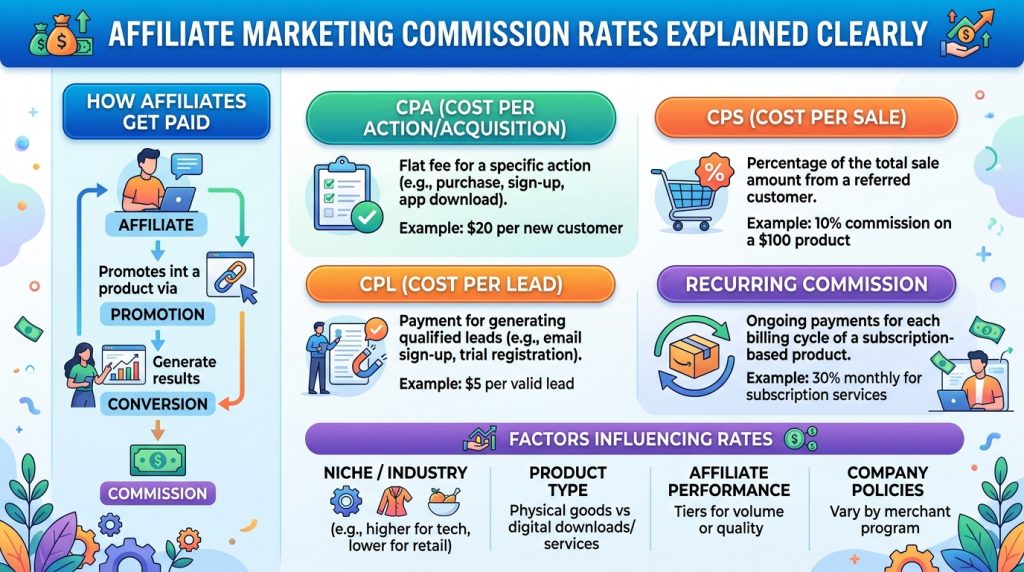
Affiliate programs utilize several commission structures, each with distinct characteristics that suit different products, services, and business objectives. Understanding these models is fundamental for both affiliates and merchants to make informed decisions and optimize their strategies. The most common structures include pay-per-sale, pay-per-lead, and recurring commissions, with variations like fixed fees, percentage-based, tiered, and hybrid models also prevalent.
Percentage-Based Commissions
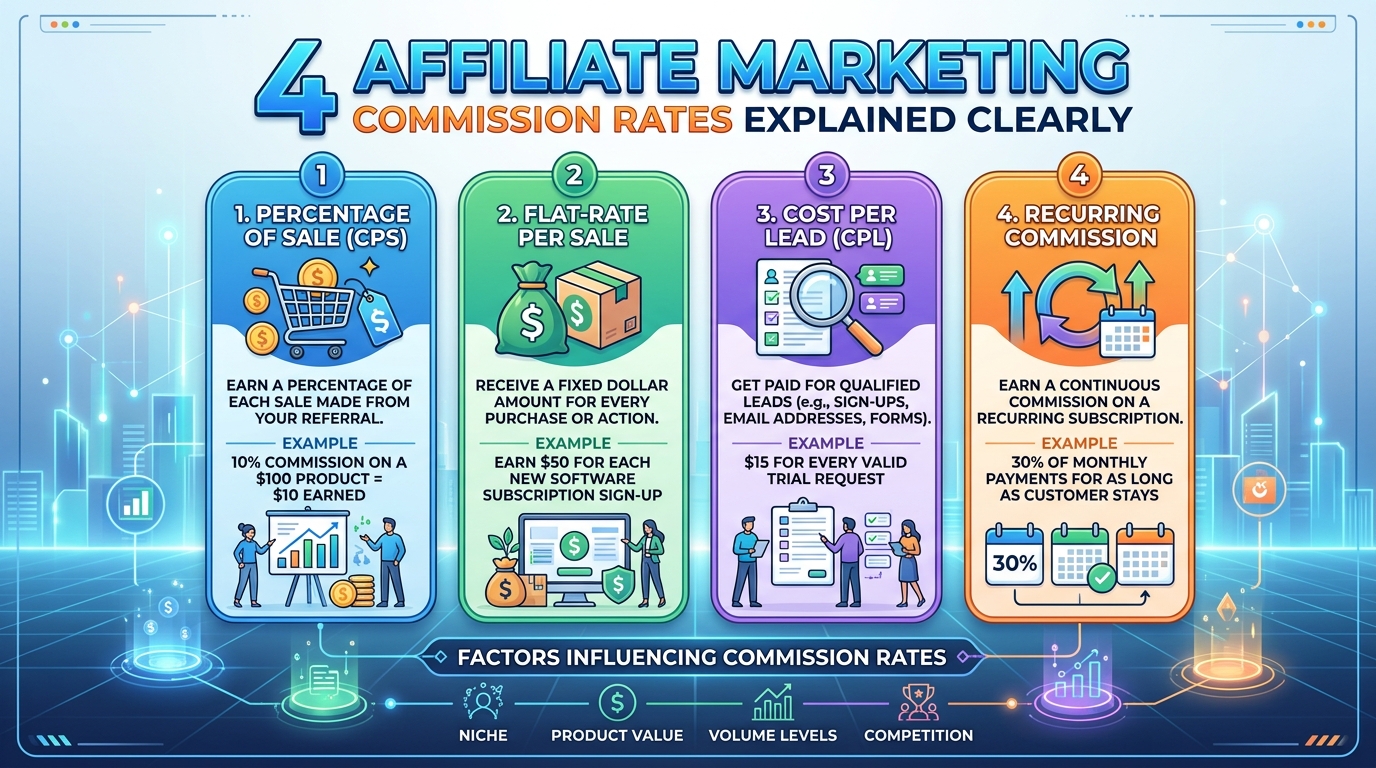
Percentage-based commissions are perhaps the most common model, especially in e-commerce and for digital products. In this structure, affiliates earn a predetermined percentage of the sale price when a customer makes a purchase through their unique affiliate link. For example, a 10% commission on a $100 product would yield a $10 payout. This model naturally incentivizes affiliates to promote higher-priced items, as a larger sale directly translates to a higher commission. It aligns affiliate earnings directly with the value they bring to the merchant. Industries like software often offer higher percentage rates compared to physical goods, due to lower marginal costs and higher profit margins associated with digital products.
Fixed-Fee Commissions
Fixed-fee commissions, also known as flat-rate commissions, offer affiliates a predetermined monetary amount for each conversion, regardless of the product’s price. This model is often simpler for budgeting and easier for affiliates to understand, as they know exactly what they will earn per action. Fixed commissions are particularly well-suited for businesses with a limited number of products or services at set prices, or for actions like lead generation (e.g., a signup or free trial) where the value of the conversion is consistent. For instance, a SaaS company might offer a fixed amount for each new qualified lead, rather than a percentage of a future subscription.
Recurring Commissions
Recurring commissions are highly attractive, particularly in subscription-based services like Software-as-a-Service (SaaS) and online education platforms. With this model, affiliates earn a percentage of ongoing payments from customers they refer, as long as the customer remains subscribed. This creates a continuous, passive revenue stream for affiliates, incentivizing them to promote high-quality products that provide long-term value and retain customers. Recurring commissions can significantly enhance affiliate motivation because their initial efforts yield benefits over an extended period, leading to more stable and predictable income. Some programs may cap the duration of these payments, with 12 months being a common limit, while others, like dYdX and ClickMagick, offer lifetime recurring commissions.
Tiered and Hybrid Models
Beyond the basic structures, many affiliate programs implement more sophisticated models like tiered and hybrid commissions to optimize performance and flexibility.
Tiered Commissions: This structure rewards affiliates with higher commission rates as their performance improves, often based on reaching certain sales volume or revenue milestones. For example, an affiliate might earn 10% for up to 30 sales, and then 15% for 50 or more sales. Tiered models encourage affiliates to scale their efforts and reward top performers, aligning the interests of both the business and the affiliate.
Hybrid Models: Hybrid commission models combine different payment structures to create flexible deals. This could involve an upfront fixed fee for a lead, combined with a percentage of a subsequent sale, or a combination of performance-based payouts and flat-rate creator partnerships. These models offer greater adaptability to various marketing strategies and can be particularly effective for complex products or services that involve multiple conversion points.
Factors Influencing Commission Rates
Several interconnected factors influence the affiliate commission rates offered by merchants. Understanding these elements is crucial for both affiliates and businesses to gauge the competitiveness and sustainability of a program.
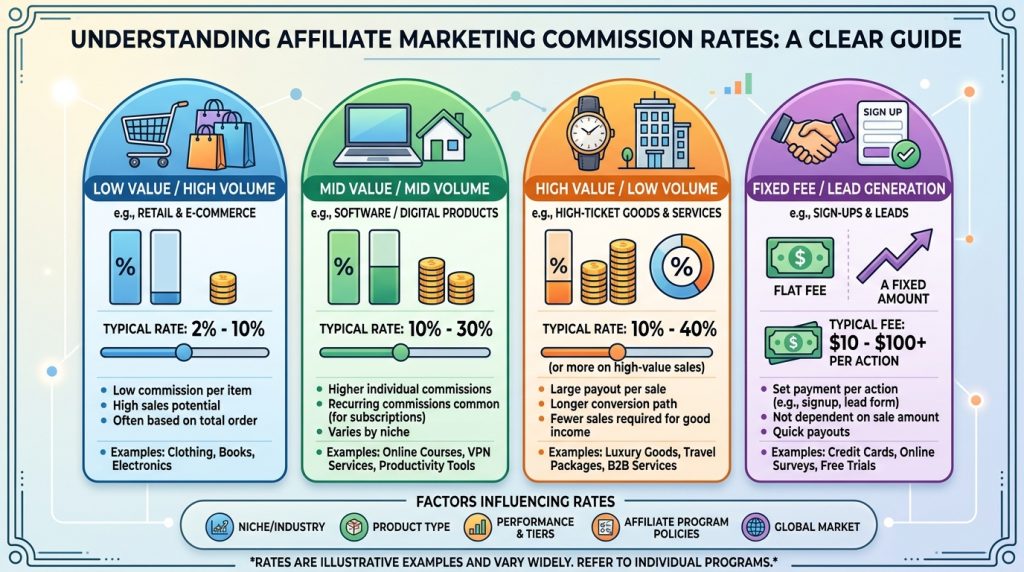
Industry and Product Type: The industry in which a product operates significantly impacts commission rates. Digital products, such as software, online courses, and e-books, typically offer higher commissions (often 20-50% or even higher) due to lower marginal costs and higher profit margins compared to physical goods. Physical products, which incur manufacturing, shipping, and fulfillment costs, generally offer lower percentages, usually ranging from 5-20%. For instance, the SaaS industry often sees recurring commissions of 20-30%, while fashion and beauty might average 8-18%. High-ticket items can sometimes offer lower percentages but result in substantial dollar amounts per sale.
Profit Margins: A merchant’s gross profit margin is a primary constraint on the commission rate they can offer. Businesses with higher profit margins can afford to pay higher commissions without significantly impacting their profitability. It is critical that commission rates do not exceed the actual profit per sale, or the business will lose money on every referral. Calculating customer lifetime value (CLV) is also essential, as commission rates should be set well below the average CLV to ensure sustainability.
Competitive Landscape: To attract quality affiliates, commission rates must be competitive within the market. If a merchant offers rates significantly lower than competitors in the same niche, they risk losing potential affiliates to programs with better compensation. Researching industry benchmarks helps avoid setting unrealistic rates.
Affiliate Performance and Value: High-performing affiliates who consistently deliver significant sales or leads may be able to negotiate better rates. Many programs reward performance through tiered commission structures, where exceeding certain sales thresholds leads to higher payouts. Affiliates who demonstrate strong conversion rates, high traffic, and a valuable audience provide more leverage in negotiations.
Customer Acquisition Cost (CAC): Merchants consider their existing customer acquisition costs when setting affiliate commissions. Ideally, the affiliate commission should fall within the range of what the business is already spending to acquire customers through other marketing channels, aiming for a reduced CAC.
Product Price and Average Order Value (AOV): High-priced products or those with a high average order value can support higher commission rates, as each sale generates more revenue. Conversely, low-cost products might require a higher percentage commission to motivate affiliates to promote them, ensuring meaningful earnings per conversion.
Conversion Rates and Cookie Duration: Products with higher conversion rates can make even a modest commission percentage attractive to affiliates, as it translates to more frequent earnings. Cookie duration, which determines how long a tracking link remains active after a user clicks it, also influences an affiliate’s potential to earn commissions on delayed purchases. Longer cookie durations generally provide affiliates a better chance of earning commissions.
Average Commission Rates Across Industries
Affiliate marketing commission rates vary significantly by industry, reflecting differences in profit margins, product values, and competitive landscapes. While the average commission typically ranges from 5% to 30%, some niches can see much higher or lower rates. Digital products and services generally command higher commissions due to lower production costs and higher profit margins.
Here’s a general overview of typical commission rate benchmarks across various industries in 2026:
| Industry/Product Category | Typical Commission Rate Range | Notes |
|---|---|---|
| SaaS & Subscription (Digital) | 20% – 30% (often recurring) | High margins, incentivizes long-term customer retention. Some offer up to 50% recurring. |
| Digital Products (e.g., e-books, courses, software) | 20% – 50% (can be 60-90% for high-ticket items) | Minimal marginal costs, high profit potential. |
| E-commerce (Physical Goods) | 5% – 20% | Varies widely by product and brand. Influenced by production, shipping, and fulfillment costs. |
| Apparel & Accessories | 8% – 15% | Often tiered for top performers, sometimes higher for first-time customer orders. |
| Health & Wellness | 8% – 15% for one-time products, higher for subscriptions. | Can include supplements, fitness programs. |
| Electronics & Gadgets | 1% – 10% | Lower due to tighter profit margins and high competition. |
| Home & Lifestyle | 8% – 12% on first orders. | Includes home decor, furniture, etc. |
| Financial Services/Fintech | Fixed fee ($50 – $200 per verified signup) or percentage | Often based on Cost Per Action (CPA) for leads or sign-ups. |
| Travel & Tours | 8% – 15% | Booking platforms (e.g., Booking.com, Viator) use varied structures, sometimes tiered. |
| iGaming & Betting | Revenue Share (1st Partners offer up to 500 EUR CPA) | Can include CPA and hybrid structures, with flexible payment terms. |
It’s important for affiliates to research specific programs within their niche to understand the exact commission rates and structures offered, as these can vary even within the same industry. For merchants, benchmarking against competitors helps in setting rates that are attractive enough to secure quality partners without eroding profitability.
Strategies for Maximizing Your Affiliate Earnings
For affiliates, maximizing earnings goes beyond simply finding high commission rates. It involves strategic planning and execution to drive conversions and build a sustainable income stream. Here are several effective strategies:
Choose the Right Niche and Products: Focus on a niche you are knowledgeable about and genuinely passionate about. Promote products that you truly believe in and that align with your audience’s needs and interests. Authenticity builds trust, which is paramount for long-term affiliate success.
Create High-Quality, Value-Driven Content: Don’t just drop links; create comprehensive, helpful, and engaging content that genuinely assists your audience. This could include in-depth reviews, tutorials, comparisons, or problem-solving guides. Optimize your content for search engines to attract organic traffic, which is highly valuable. The best way to earn from affiliate links is by creating posts specifically designed to “sell” those links, not just randomly adding them to existing content.
Diversify Promotion Channels: While blog posts are a cornerstone, explore other channels like email marketing, social media, YouTube, and even paid advertising to reach a wider audience. Tailor your content to each platform for maximum impact. Building an email list, for instance, allows for direct engagement and targeted promotions.
Optimize Link Placement and Calls to Action: Strategically place your affiliate links within your content where they are most relevant and noticeable. Use clear and compelling calls to action (CTAs) to guide users towards making a purchase.
Build Strong Relationships with Merchants/Affiliate Managers: Communicating regularly with affiliate managers, offering feedback, and showing genuine interest in a program’s success can lead to better terms and exclusive opportunities. This relationship building is key for future negotiations.
Leverage Performance Data: Continuously monitor your performance metrics, such as conversion rates, click-through rates, and earnings per click (EPC). Identify what works best and refine your strategies accordingly. This data is also crucial for negotiating higher commissions.
Offer Bonuses: Some affiliates increase their conversions by offering exclusive bonuses to customers who purchase through their links. This could be a supplementary guide, a free consultation, or access to a private community.
Stay Updated with Trends: The affiliate marketing landscape is constantly evolving. Staying informed about new products, tools, platforms, and strategies can give you a competitive edge.
The Role of Affiliate Networks in Commission Management
Affiliate networks play a pivotal role in connecting merchants with affiliates and facilitating the entire affiliate marketing process, including the crucial aspect of commission management. These platforms act as intermediaries, streamlining operations for both parties.
For merchants, affiliate networks provide a robust infrastructure for managing their affiliate programs. This includes:
Tracking and Attribution: Networks offer sophisticated tracking technology that accurately monitors clicks, conversions, and sales, ensuring that affiliates receive credit for every referral. This unbiased tracking is essential for transparent commission calculations.
Payment Processing: One of the significant benefits for both parties is consolidated payments. Instead of affiliates receiving numerous small checks from different merchants, networks bundle all commissions into a single, reliable monthly payment once an affiliate meets the payout threshold (often $50-$100). This simplifies accounting and reduces administrative burden.
Affiliate Recruitment and Management: Networks provide a marketplace where merchants can list their programs and attract a wide range of affiliates. They also offer tools for managing affiliates, distributing promotional materials, and communicating effectively.
Compliance and Fraud Detection: Many networks have strong compliance frameworks and fraud detection mechanisms in place to ensure trustworthy and transparent operations, protecting both merchants and affiliates.
For affiliates, networks offer a centralized hub to discover new programs, compare commission rates, and manage their diverse portfolio of promotions. They provide access to thousands of merchants across various niches, making it easier to find relevant products to promote. Some well-known networks include Rakuten Advertising, ShareASale, CJ Affiliate, and Impact, each offering different merchants and commission structures. The networks also provide essential data, such as cookie duration and payout thresholds, helping affiliates choose programs that align with their goals. Furthermore, some networks like 1st.Partners offer flexible commission models, including revenue share, CPA, and hybrid structures, with various payment methods and dedicated support for affiliates.
Negotiating Higher Commission Rates
While many affiliate programs have standard commission rates, experienced and high-performing affiliates often have room to negotiate for higher payouts. Successful negotiation requires a strategic approach, focusing on the value an affiliate brings to the merchant.
Here are key tips for negotiating higher commission rates:
Demonstrate Your Value with Data: The most compelling argument for a higher commission is proof of performance. Present detailed analytics showcasing your traffic volume, engagement rates, conversion metrics, and the revenue you’ve already generated for the merchant. Highlight your unique selling proposition, audience demographics, and any brand-building successes. Brands respond to numbers, not just “good vibes”.
Build a Strong Relationship with Affiliate Managers: Develop a rapport and mutual understanding with your affiliate manager. Regular communication, offering suggestions, and expressing a genuine interest in the program’s success can build trust and open doors for negotiation.
Research Industry Standards and Competitor Rates: Be informed about what competitors are offering in your niche. This knowledge provides leverage and helps you understand what constitutes a fair and competitive rate. You can even highlight what competitors are doing right (or wrong) to show the brand the bigger picture.
Propose Performance-Based Tiers: Instead of an immediate bump across the board, suggest a tiered commission structure where you earn a higher rate after reaching specific sales or revenue milestones. This demonstrates your commitment to driving results and reduces the merchant’s risk, as they only pay higher rates for proven performance.
Highlight Your Promotional Strategy: Clearly articulate how you plan to market the product and the specific content strategies you will leverage. Show the merchant your commitment to effectively promoting their products or services, making you appear as a valuable partner worth investing in.
Offer Added Value: Consider offering additional services or benefits that would be valuable to the merchant. For example, you could propose conducting audience sentiment analysis to provide feedback for future campaigns in exchange for a higher rate.
Be Persistent and Flexible: Negotiation might not yield immediate results. Be prepared to compromise and explore various options. Maintain flexibility in your bargaining tactics based on the program’s feedback and requirements.
Understand Your Leverage: If you are a high-volume publisher generating significant traffic and sales, you have leverage. Don’t be afraid to use it, subtly or directly, by showing that you have other profitable options.
For a more detailed overview of affiliate marketing as a whole, consider exploring resources like Wikipedia’s comprehensive article on affiliate marketing, which delves into its history, models, and impact on the digital economy.
Legal and Ethical Considerations
Engaging in affiliate marketing, while lucrative, comes with a set of legal and ethical responsibilities that both affiliates and merchants must uphold. These considerations are crucial for building trust with an audience, maintaining brand reputation, and avoiding legal repercussions.
Transparency and Disclosure: One of the most critical ethical and legal requirements is transparency regarding affiliate relationships. The Federal Trade Commission (FTC) in the United States, and similar regulatory bodies globally, mandate that affiliates clearly and conspicuously disclose their partnerships with brands when promoting products or services. This means using clear language like “This post contains affiliate links” or “I may earn a commission if you purchase through them”. Disclosures should be easily noticeable, placed prominently near affiliate links, and consistent across all platforms (blogs, social media, videos). Hidden disclaimers or fine print are generally not sufficient.
Honest and Truthful Endorsements: Affiliates must ensure that any claims made about a product are honest, accurate, and not misleading. Exaggerated claims, false reviews, or misleading promises can harm consumers and merchants alike, potentially leading to legal action. If endorsing a product based on personal experience, it must genuinely reflect the affiliate’s own use and results. For products with health or scientific claims, these should be backed by evidence.
Data Privacy and Compliance Regulations: With increasing concerns over data privacy, affiliates must comply with relevant laws like the General Data Protection Regulation (GDPR) and the California Consumer Privacy Act (CCPA). This involves avoiding tracking users without consent and clearly communicating how user data is collected and used. Affiliates should work with networks and programs that prioritize data protection.
Avoid Deceptive Tactics: Practices such as spamming, creating fake websites, or using copyrighted/trademarked material without permission are unethical and often illegal. Affiliates should avoid any unfair competition practices that could harm the consumer or the merchant’s reputation. Focusing on long-term audience trust through helpful content and honest recommendations is key to sustainable affiliate success.
Brand Alignment and Reputation: Affiliates should only promote products that align with their brand’s values and ethos. Partnering with reputable brands helps maintain credibility and ensures the promotion of valuable products. Merchants, in turn, should establish a code of conduct and ethical standards for their affiliates and monitor their activities to ensure compliance.
Conclusion
Affiliate marketing commission rates are far more than just numbers; they are the strategic foundation upon which successful affiliate partnerships are built. From the foundational percentage-based and fixed-fee models to the highly coveted recurring and performance-driven tiered structures, understanding these mechanisms is paramount for both merchants seeking to incentivize their partners and affiliates striving for sustainable income. Factors such as industry type, product margins, competitive benchmarks, and an affiliate’s proven performance all play a critical role in determining what constitutes a fair and effective commission. By strategically choosing programs, leveraging data-driven insights, and fostering strong relationships, affiliates can significantly maximize their earnings. Simultaneously, merchants must set competitive rates that align with their business economics to attract and retain top talent. Adhering to legal and ethical guidelines, particularly concerning transparency and honest endorsements, is not just a matter of compliance but a cornerstone of building enduring trust and a reputable presence in the ever-evolving digital landscape. Ultimately, a clear understanding and strategic approach to affiliate marketing commission rates are essential ingredients for long-term success in this dynamic industry.