Affiliate Marketing Income Guide: How Much Can You Really Earn?
Table of Contents
Affiliate marketing has emerged as a dynamic and increasingly popular avenue for individuals and businesses to generate income online. With the global affiliate marketing industry projected to reach an impressive $27.78 billion by 2027, and currently valued at approximately $17 billion, the potential for substantial earnings is undeniable. However, behind the glossy testimonials of “super affiliates” earning six and seven figures, lies a nuanced reality. This comprehensive guide aims to demystify affiliate marketing income, offering a realistic breakdown of what you can truly earn, the factors that influence your success, and actionable strategies to maximize your profitability.
Understanding Affiliate Marketing: The Basics
Affiliate marketing is a performance-based marketing strategy where individuals, known as affiliates, earn a commission for promoting another company’s products or services. It’s a symbiotic relationship: affiliates drive traffic and sales to a merchant, and in return, they receive a share of the revenue. This process typically involves unique affiliate links that track referrals and attribute conversions to the specific affiliate.
The core components of affiliate marketing involve three main parties:
- The Merchant (Advertiser): This is the company or individual who creates the product or service. They pay commissions to affiliates for driving sales.
- The Affiliate (Publisher): This is you, the marketer. You promote the merchant’s products to your audience through various channels, such as websites, blogs, social media, or email lists.
- The Consumer: The end-user who purchases the product or service through the affiliate’s unique link.
Commission structures can vary widely, but the most common models include pay-per-sale (PPS), pay-per-lead (PPL), and occasionally pay-per-click (PPC).
The Realities of Affiliate Marketing Income: What to Expect
The honest answer to “how much do affiliate marketers make” is that it varies drastically, ranging from $0 to over $1 million per month. While social media gurus might flash dashboards showing massive monthly incomes, these numbers are often skewed by a small percentage of “super affiliates.”
Recent data indicates that approximately 41% of affiliate marketers earn less than $1,000 per month, while a smaller 9% earn over $50,000 per month. The average affiliate marketer earns around $8,038 per month, or roughly $96,336 annually. However, this average is heavily influenced by top earners, and the median income is considerably lower, with many marketers earning between $500 and $2,500 monthly.
Your income potential is strongly tied to your experience level:
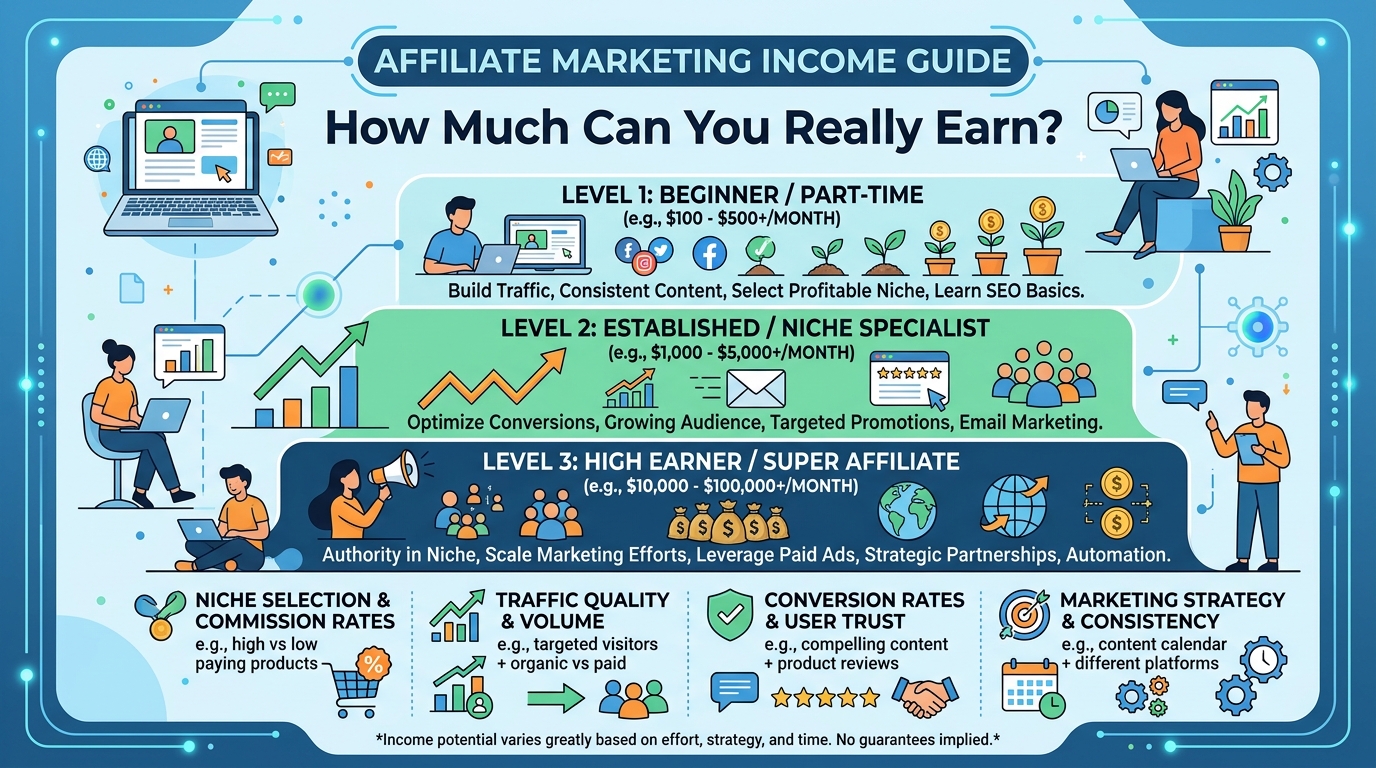
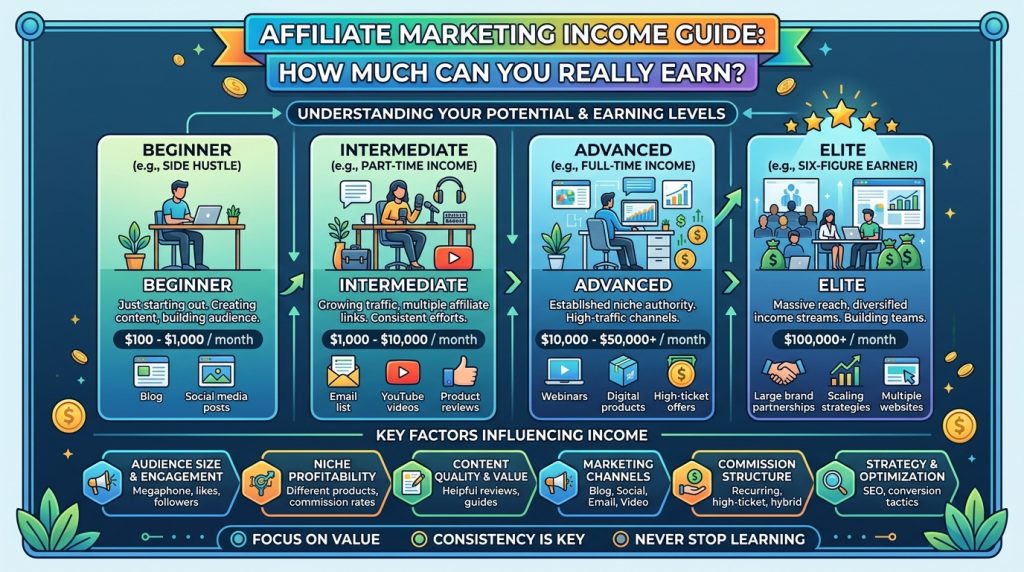
- Beginners (0-1 year): Typically earn between $0 and $1,000 per month. Many beginners may not earn anything for the first 6-12 months as they build their platforms and content.
- Intermediate Marketers (1-3 years): Can expect to earn $1,000 to $10,000 per month.
- Advanced Marketers (3-5+ years): Earnings can range from $10,000 to $100,000 per month.
- Super Affiliates (5+ years): These elite marketers, often with massive audiences and expertise in high-ticket niches, can earn $100,000 or more per month.
It’s crucial to understand that affiliate marketing is not a “get-rich-quick” scheme. It’s an active business model requiring upfront work, consistency, and dedication. Expect it to take 6 to 12 months to see your first consistent commissions and potentially two or more years to build a substantial, job-replacing income.

Key Factors Influencing Your Affiliate Marketing Earnings
Several variables determine how much you can earn in affiliate marketing. Understanding these factors is essential for optimizing your income potential:
- Niche Selection: The choice of niche is arguably the most critical decision, impacting profitability and competition levels.
- Audience Size and Engagement: You cannot make money without an audience. A larger, more engaged audience generally leads to higher earnings.
- Traffic Quality and Quantity: High-quality, targeted traffic from relevant sources is more likely to convert into sales than generic traffic.
- Conversion Rates: The percentage of visitors who take the desired action (e.g., make a purchase) is critical.
- Commission Rates and Program Choice: Different affiliate programs offer varying commission models and rates.
- Product Quality and Relevance: Promoting high-quality products that genuinely align with your audience’s interests enhances credibility and trust.
- Experience Level: As noted, income generally increases significantly with experience.
Niche Selection: The Foundation of Profitability
Choosing a profitable niche is paramount to success in affiliate marketing. A niche is a specific, focused market segment that you target with your content and promotions. Instead of broadly targeting “fitness,” you might focus on “home workout routines for beginners.”
Profitable niches often have high demand and offer products or services with a good customer lifetime value. Some of the highest-paying niches include:
- SaaS (Software-as-a-Service): Often offers high recurring commissions (20-50%).
- Finance: Includes credit cards, insurance, and investing, with commissions ranging from $50 to $200+ per conversion.
- Education and E-Learning: Leads profitability with average monthly earnings of $15,551 due to high-ticket course prices and recurring commission models.
- Health and Wellness: A sector with high demand and many high-commission products.
- Tech Gadgets & Software: A rapidly evolving and profitable niche.
- Travel: Offers higher commission rates due to expensive products and significant purchases.
While high-paying niches can be very lucrative, they are often more competitive. It’s essential to find a balance between profitability and an area you have genuine interest and expertise in to build authenticity and create valuable content.
Traffic Generation Strategies and Their Impact
Generating high-quality traffic to your affiliate links is crucial. “Traffic is the lifeblood of any online business.” Not all traffic is equal; targeted traffic with high intent is far more valuable.
Common traffic sources include:
- Search Engine Optimization (SEO): 78% of successful affiliates use SEO as a primary traffic source. It generates high-quality, high-intent organic traffic by ranking content in search engines.
- Email Marketing: Often cited as the highest ROI channel because you own the audience and can build deep trust.
- Social Media Marketing: Platforms like Facebook, Instagram, YouTube, and TikTok can drive significant traffic. Social media accounts for 25% of all affiliate traffic.
- Content Marketing: Creating valuable blog posts, articles, product reviews, and videos helps attract and engage an audience.
- Paid Ads (PPC, Display Ads): Platforms like Google Ads, Bing Ads, and Facebook Ads can quickly generate targeted traffic. This is an advanced strategy but can yield quick results, though with higher costs.
A resilient strategy often combines organic and paid methods to create multiple independent revenue streams.
| Experience Level | Monthly Income Range | Key Characteristics |
|---|---|---|
| Beginner (0-1 Year) | $0 – $1,000 | Focus on learning, platform building, SEO fundamentals. Often no earnings for 6-12 months. |
| Intermediate (1-3 Years) | $1,000 – $10,000 | Improved marketing skills, growing audience, consistent traffic sources, refined strategies. |
| Advanced (3-5 Years) | $10,000 – $100,000 | Mastered niches, significant audience engagement, optimized conversion funnels, strong brand authority. |
| Super Affiliate (5+ Years) | $100,000+ | Elite marketers with massive audiences, expertise in high-ticket niches, diversified income streams. |
Commission Structures and Affiliate Program Types
Understanding how you get paid is fundamental. Affiliate programs offer various commission structures:
- Pay-Per-Sale (PPS): The most common model, where affiliates earn a percentage of the sale or a fixed amount only when a referred customer makes a purchase. Commission rates typically range from 5% to 75%, varying by product and industry. For example, physical goods might offer 5-15%, while digital products can offer 20-50%.
- Pay-Per-Lead (PPL): Affiliates earn a commission for generating qualified leads, such as a customer filling out a form or signing up for a trial. Payouts can range from $5 to $100 per lead.
- Pay-Per-Click (PPC): Less common for affiliates, this model pays for each click on the affiliate link, regardless of a sale or lead. It’s more focused on driving traffic and brand awareness.
- Recurring Commissions: Common in subscription-based services, affiliates earn a percentage of ongoing payments from referred customers for as long as they remain subscribed. This creates a stable, continuous revenue stream. Many programs offer 15-30% recurring payments for subscription services.
- Tiered Commissions: These programs motivate affiliates to sell more by increasing commission rates as they reach certain sales milestones.
High-ticket products and services, especially in niches like SaaS and finance, often offer higher commission rates or significant flat fees, which can substantially boost earnings.
Strategies to Maximize Your Affiliate Marketing Income
To move beyond beginner earnings and build a truly lucrative affiliate business, strategic execution is key. Here are proven strategies:
- Niche Down and Specialize: Instead of being a generalist, focus on a very specific sub-niche (“one inch wide and one mile deep”). This allows you to build authority and target an audience with specific needs.
- Create High-Quality, Value-Driven Content: Don’t just drop links; create compelling content that educates, solves problems, and genuinely helps your audience. This builds trust and positions you as an expert. High-quality content is a primary driver for SEO success.
- Optimize for Conversions: Focus on conversion rate optimization (CRO). This includes clear calls to action, compelling product descriptions, social proof (testimonials, reviews), and a streamlined user experience. Offering coupons or limited-time promotions can also significantly boost conversion rates.
- Diversify Traffic Sources: Relying on a single traffic source is risky due to potential algorithm changes or platform policy shifts. Combine SEO, email marketing, social media, and potentially paid ads for a more resilient strategy.
- Promote High-Converting & Relevant Products: Choose products you genuinely believe in and that directly address your audience’s needs. Promoting products based solely on high commission rates without considering relevance can damage credibility. Consider products with recurring commissions for more stable income.
- Build an Email List: Email marketing consistently offers the highest ROI in affiliate marketing. It allows for direct communication, deeper trust-building, and consistent promotional opportunities.
- Track and Analyze Performance: Regularly monitor your metrics, including click-through rates, conversion rates, and earnings per click. This data helps you understand what’s working and where to optimize.
- Stay Updated with Trends: The digital landscape is constantly evolving. Staying informed about new products, marketing techniques, and platform changes allows you to adapt and seize new opportunities.
Building Trust and Authority: Your Long-Term Asset
In the crowded affiliate marketing space, trust and authority are your most valuable assets. Consumers are increasingly wary of overt sales pitches and are more likely to purchase from sources they trust. To cultivate this, prioritize transparency and authenticity. Be honest about your affiliate relationships and only recommend products you genuinely believe in and would use yourself.
Creating comprehensive, unbiased reviews and tutorials, engaging with your audience, and consistently delivering value will establish you as a credible expert in your niche. This long-term approach fosters a loyal audience, which in turn leads to higher conversion rates and sustainable income. As highlighted by impact.com, “The best creators tap into overlooked tactics that drive stronger affiliate relationships, higher earnings, and brand deals that last.”
For more insights into effective digital marketing strategies that build trust and drive conversions, consider exploring resources from reputable sources like HubSpot’s guide to digital marketing strategy.
The Journey from Beginner to High Earner
The path to becoming a high-earning affiliate marketer is a journey that requires patience, persistent effort, and continuous learning. Most affiliates see their first commissions within 3-6 months, but achieving meaningful income (over $1,000/month) typically takes 6-12 months of consistent effort.
Many beginners make the mistake of expecting quick results and give up too early when they don’t see immediate sales. Success builds over time, with each piece of content, every link shared, and every interaction contributing to your overall growth.
The key is to approach affiliate marketing as a long-term business, not a get-rich-quick scheme. Continuously test new promotional tools, craft engaging content, and actively use various affiliate programs from top brands. Those who adapt, optimize, and remain dedicated to providing value to their audience are the ones who ultimately achieve significant and sustainable income in this dynamic industry.
Conclusion
Affiliate marketing undeniably offers immense earning potential, with the industry experiencing consistent growth. While the average affiliate marketer earns a respectable income, the spectrum is wide, heavily influenced by experience, niche selection, traffic quality, and strategic execution. From beginners earning modest amounts to “super affiliates” generating seven-figure incomes, the possibilities are diverse.
The journey to significant affiliate marketing income is rarely instant. It demands a commitment to understanding your audience, selecting profitable niches, generating high-quality traffic, optimizing conversion rates, and building genuine trust and authority. By focusing on creating value, continuously learning, and applying consistent effort, you can navigate the complexities of this exciting industry and truly earn a substantial income.