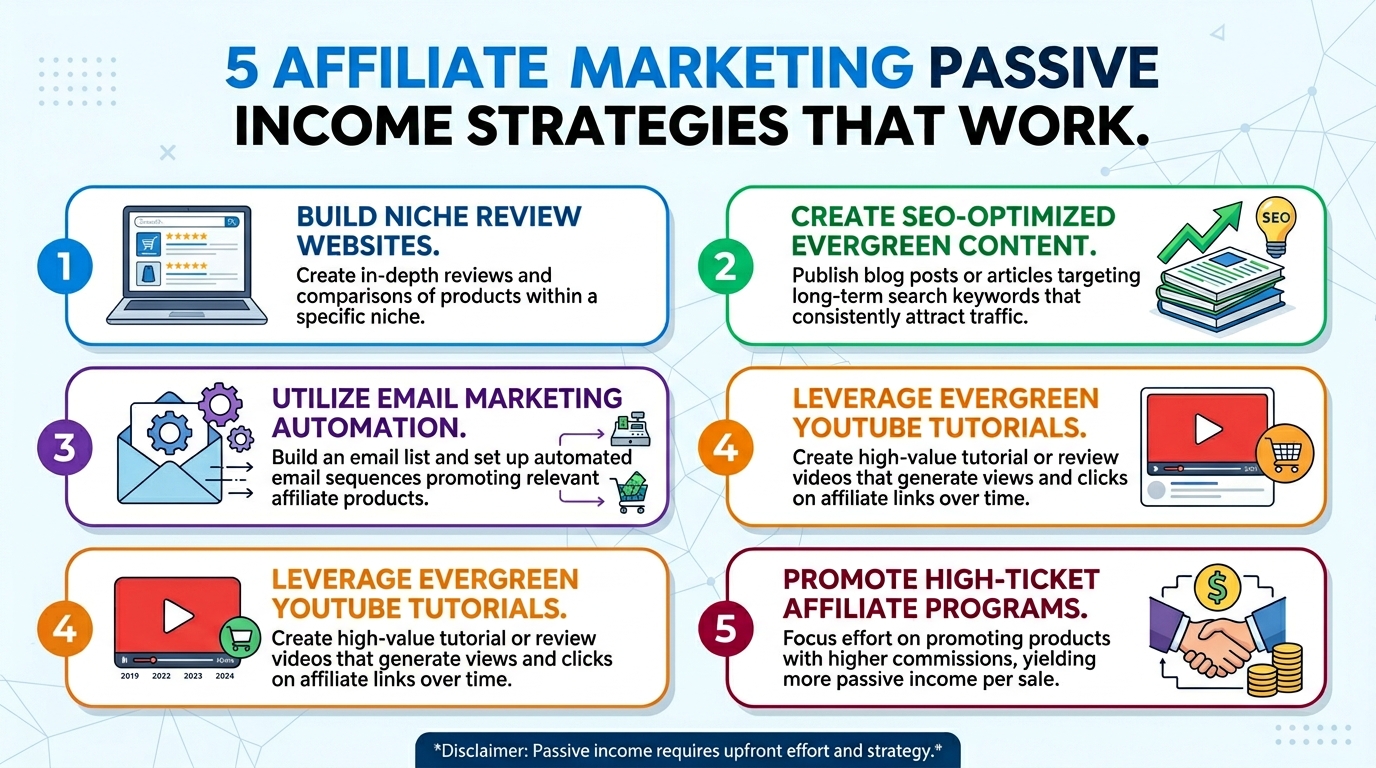
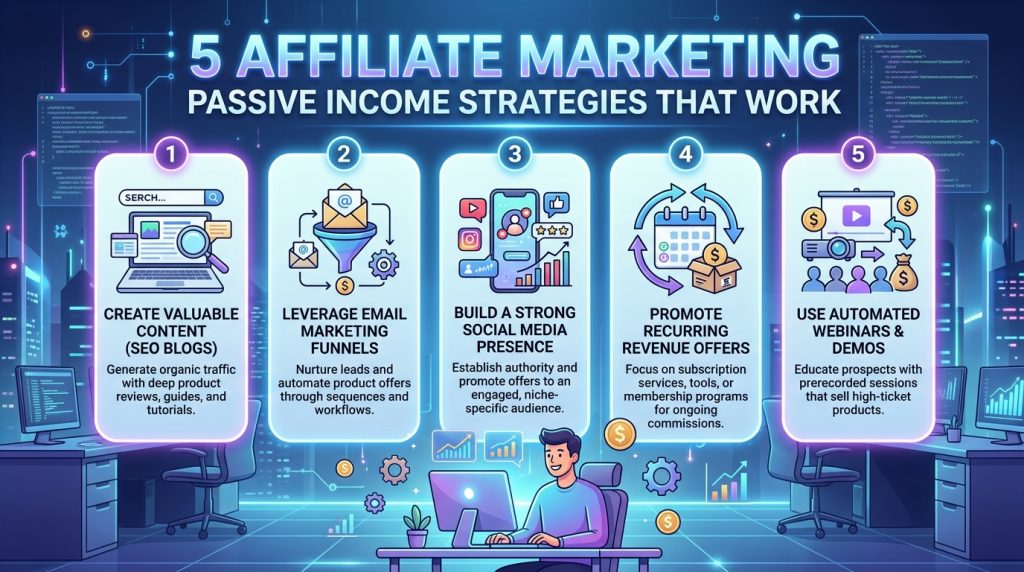
5Affiliate Marketing Passive Income Strategies That Work
Table of Contents
Affiliate marketing offers a dynamic and increasingly popular pathway to generating passive income, allowing individuals to earn commissions by promoting other businesses’ products or services. Unlike traditional employment, where income is directly tied to hours worked, affiliate marketing, when strategically implemented, can create revenue streams that continue long after the initial effort. This performance-based strategy involves an affiliate sharing unique links or ads on their chosen platforms, such as websites, blogs, or social media. When a consumer clicks these links and completes a desired action, like making a purchase or signing up for a service, the affiliate earns a commission. The beauty of this model lies in its flexibility and potential for unlimited income, as affiliates aren’t confined to fixed schedules or locations.
The global affiliate marketing industry is robust, valued at approximately $17 billion and projected to reach $27.78 billion by 2027. This growth underscores its effectiveness as a cost-efficient marketing strategy for businesses and a lucrative opportunity for individuals. The key to unlocking truly passive income through affiliate marketing, however, lies in understanding and implementing strategies that focus on long-term value creation and automation, rather than constant manual intervention. This article will delve into comprehensive strategies that work, guiding you through the process of building a sustainable and profitable affiliate marketing business.
Understanding the Core of Passive Affiliate Marketing
At its heart, passive affiliate marketing revolves around setting up systems that generate income without requiring your constant, active presence. While the initial setup demands significant effort, the goal is to create assets that continue to attract traffic and conversions on autopilot. The core components typically involve four main actors: the merchant (the business selling the product or service), the affiliate (you, the promoter), the consumer (the buyer), and often an affiliate network (a platform connecting merchants and affiliates).
The process is straightforward: an affiliate joins a program, receives unique tracking links, and promotes products or services through content. When a consumer interacts with these links and makes a purchase, the affiliate earns a commission. The “passive” element comes into play when the content and promotional efforts continue to draw new customers over time without requiring ongoing manual promotion. This could be through evergreen blog posts that rank well in search engines, automated email sequences, or YouTube videos that continue to get views. Recurring commissions, especially from subscription-based products like Software as a Service (SaaS), are particularly potent for passive income, as they offer continuous earnings as long as the referred customer remains a subscriber.
Strategic Niche and Product Selection for Long-Term Income
The foundation of any successful affiliate marketing venture, especially one aiming for passive income, is choosing the right niche and products. A well-defined niche allows you to target a specific audience, reducing competition and increasing the relevance of your promotions. It’s crucial to select niches with sustained demand, long-term growth prospects, and genuine customer interest.
- Evergreen Niches: Focus on areas that consistently attract interest regardless of short-term trends. Health and wellness, personal finance, technology (especially SaaS), and education (e-learning) are consistently cited as highly profitable and evergreen niches. These areas address fundamental human needs or continuous market evolution, ensuring a steady audience.
- Passion vs. Profitability: While passion can fuel consistency, profitability is key for income. Ideally, find a sweet spot where your interest aligns with market demand and good commission rates. Avoid promoting companies with questionable product quality or poor customer service, as this can damage your credibility.
- High-Ticket and Recurring Commission Products: For true passive income, high-ticket items (which offer larger one-time commissions) and products with recurring revenue models (like subscriptions) are invaluable. SaaS products, for instance, often provide recurring commissions, ensuring continuous earnings as long as the customer you referred remains subscribed.
- Product Quality and Relevance: Always prioritize promoting products you genuinely believe in and that provide real value to your audience. Authenticity builds trust, which is paramount for long-term affiliate success.
Creating Evergreen Content: Your Passive Income Engine
Content is the vehicle for your affiliate links, and for passive income, that content needs to have a long shelf life. “Evergreen content” remains relevant and valuable to your audience over an extended period, continuously attracting traffic and potential conversions without constant updates.
- Informative Blog Posts and Guides: In-depth tutorials, “how-to” guides, ultimate guides, and resource lists are excellent examples. These pieces answer common questions, solve problems, and naturally integrate affiliate product recommendations as solutions. For instance, a fitness blog might embed links to fitness equipment or supplements within a workout guide.
- Product Reviews and Comparisons: Detailed reviews that highlight pros, cons, and user experiences build trust and help consumers make informed decisions. Comparison articles (e.g., “Best X vs. Y”) are powerful for capturing users with commercial intent, often leading directly to sales. Google’s “Product Reviews Update” emphasizes the need for content that demonstrates real experience, expertise, authoritativeness, and trustworthiness (E-E-A-T).
- Video Content: YouTube videos, including in-depth reviews, tutorials, and unboxings, can generate significant passive income. Many successful affiliate marketers embed their links directly in video descriptions. Videos can attract thousands or millions of views, leading to substantial passive earnings.
- Solving Problems: The most effective content focuses on solving a problem for your audience, positioning the affiliate product as the optimal solution. This value-driven approach is key to engaging readers and encouraging them to click your links.
SEO Mastery: Attracting Organic Traffic Consistently
Search Engine Optimization (SEO) is arguably the most critical component for generating passive affiliate income. By optimizing your content to rank high in search engine results, you ensure a continuous stream of targeted, organic traffic to your affiliate offers, often leading to higher conversion rates compared to paid ads.
Here are key strategies for mastering SEO in affiliate marketing:
- Keyword Research: This is the bedrock of SEO. Identify terms and phrases your target audience uses, focusing on long-tail keywords which are less competitive and more specific, making them easier to rank for initially. Use tools like Google Keyword Planner, Ahrefs, or SEMrush to find keywords with decent search volume but fewer competitors. Categorize keywords by user intent: informational (e.g., “how to”), commercial (e.g., “best X,” “X vs. Y”), and transactional (e.g., “buy X model”).
- High-Quality, SEO-Optimized Content: Your content must be valuable, informative, and engaging. Naturally integrate your target keywords throughout your content, including in title tags, meta descriptions, and header tags (H1, H2, H3). Ensure your primary keyword appears in the first 100 words, the H1, and at least one H2.
- On-Page SEO: Beyond keywords, optimize other on-page elements. This includes crafting compelling title tags and meta descriptions to improve click-through rates, using clear and descriptive URL structures, optimizing images with relevant alt text, and ensuring fast page loading speeds.
- Technical SEO: Ensure your website is visible to search engines. This involves having a mobile-friendly website, proper site architecture, and using schema markup to help search engines understand your content better.
- Link Building: Backlinks from reputable sites signal to search engines that your content is trustworthy and relevant, boosting your site’s authority. Strategies include guest blogging on other niche-relevant sites, content outreach to request links, and creating “link-worthy” content like original research or in-depth guides.
- Monitor and Adapt: Regularly track your content’s performance using tools like Google Analytics and Google Search Console to monitor organic traffic, keyword rankings, and affiliate conversions. This data allows you to refine your SEO strategy continuously.
Automated Email Marketing: Nurturing Leads and Driving Sales
Email marketing is a direct line to your potential customers and, when automated, becomes a powerful passive income tool. It allows you to nurture leads, deliver value, and promote affiliate products without constant manual intervention. Around 22.8% of affiliate marketers use email marketing as a leading traffic source, with those who employ it seeing 66.4% more conversions. The global email marketing market is expanding significantly, projected to reach $17.9 billion by 2027.
Automated emails generate significantly more revenue than standard, non-automated emails, with a 320% higher return and 332% higher click rates. They also boast higher open rates, with automated messages having a 70% higher open rate than generic emails.
Here’s how to leverage email automation:
- Build an Email List: Offer valuable incentives like free e-books, exclusive content, or mini-courses in exchange for email addresses. This is your most valuable asset, giving you direct access to an interested audience.
- Automated Sequences (Funnels): Design a series of emails that automatically send based on user actions or predefined triggers. Examples include:
- Welcome Series: Introduce new subscribers to your brand, offer valuable content, and subtly introduce affiliate products relevant to their interests.
- Educational Sequences: Provide a multi-part series on a specific topic, weaving in affiliate product recommendations as solutions at appropriate points.
- Product-Specific Funnels: If someone clicks an affiliate link but doesn’t convert, you can send a follow-up sequence with more information, reviews, or testimonials about that product.
- Re-engagement Campaigns: Target inactive subscribers to bring them back into your ecosystem.
- Segmentation: Segment your audience based on their interests, past interactions, or demographics. This allows you to send highly personalized and relevant emails, which significantly boosts conversion rates.
- Value-First Approach: While promoting affiliate products, always ensure your emails provide genuine value. Over-promotion can lead to unsubscribes. Balance recommendations with helpful tips, insights, and exclusive content.
- Choose the Right Platform: Utilize email marketing platforms (e.g., GetResponse, Mailchimp, ActiveCampaign) that offer robust automation, segmentation, and analytics features to streamline your efforts.
| Strategy Element | Passive Income Contribution | Key Action for Implementation |
|---|---|---|
| Niche Selection | Ensures sustained audience interest and high-value product access. | Research evergreen, high-demand niches with recurring commission opportunities (e.g., SaaS, Health, Finance). |
| Evergreen Content | Attracts continuous organic traffic and generates sales over time without constant updates. | Create in-depth reviews, tutorials, and comparison guides that solve audience problems. |
| SEO Mastery | Drives free, targeted traffic from search engines consistently. | Perform thorough keyword research, optimize on-page elements, build quality backlinks. |
| Email Automation | Nurtures leads and sells products on autopilot through pre-set sequences. | Build an email list, create welcome and follow-up sequences, segment subscribers for personalization. |
| Diversification | Reduces risk and expands income potential across multiple sources. | Promote products from various affiliate programs and networks, explore different content types. |
| Recurring Commissions | Provides a stable, predictable monthly income stream from past efforts. | Prioritize affiliate programs offering subscriptions or repeat purchases. |
Diversifying Your Affiliate Income Streams
Relying on a single niche, traffic source, or affiliate program can be risky. Diversification is key to building truly resilient passive income streams. This involves expanding your efforts across different areas to mitigate potential losses from algorithm changes, program closures, or shifts in market demand.
- Multiple Niches: Once you establish success in one niche, consider exploring related or entirely new ones. This spreads your risk and taps into broader market opportunities. Pat Flynn of Smart Passive Income, a highly successful affiliate marketer, started with a niche he was passionate about and then diversified, emphasizing the importance of trust and valuable content across his ventures Smart Passive Income.
- Various Affiliate Programs and Networks: Don’t limit yourself to just one. Explore different affiliate networks (e.g., Amazon Associates, ClickBank, ShareASale) and direct merchant programs. Each may offer different commission structures, product varieties, and target audiences. Amazon Associates, for example, is popular for its vast product selection, while ClickBank is known for high commissions on digital products.
- Different Content Formats: Beyond blogs, leverage YouTube, podcasts, social media (especially for nano and micro-influencers who have higher engagement), and even short-form video content. Each platform attracts a different audience and offers unique ways to integrate affiliate promotions.
- Combining Strategies: Integrate SEO, email marketing, and content creation. Your SEO efforts drive traffic to your content, which then captures emails for automated sequences, reinforcing your passive income loop.
Scaling for Greater Passive Income
Once your foundational passive income streams are established, scaling involves expanding your reach and optimizing your efforts to maximize earnings without proportional increases in manual work. While affiliate marketing often requires an initial investment of time, the goal is to see that investment yield continuous returns.
- Content Expansion: Systematically create more evergreen content. This means more blog posts, more videos, and more resources that target new keywords and audience segments within your niche. Consider hiring writers or virtual assistants to scale content production while you maintain editorial oversight.
- Funnel Optimization: Continuously analyze and optimize your automated sales funnels. This includes A/B testing email subject lines, call-to-actions, landing page designs, and the flow of your email sequences to improve conversion rates. Even small improvements in conversion rates can lead to significant increases in passive income.
- Leveraging AI and Automation Tools: AI is increasingly reshaping affiliate marketing. AI solutions can simplify processes, personalize experiences, optimize campaigns, and even assist with content creation and data analysis. Tools that use AI to generate email subject lines or optimize campaign copy can be particularly beneficial for passive income streams. Marketing teams using automation can reduce campaign production time by up to 40%.
- International Expansion: If your products and content have global appeal, consider translating and localizing your content for international markets to tap into new audiences.
- Strategic Partnerships: Collaborate with other affiliates or content creators in complementary niches. This can involve guest posts, joint webinars, or cross-promotion, expanding your reach to new audiences without direct advertising costs.
Common Pitfalls and How to Avoid Them
While the allure of passive income through affiliate marketing is strong, there are common mistakes that can hinder success. Avoiding these pitfalls is crucial for building a sustainable business.
- Lack of Value: Over-promoting products without providing genuine value to your audience is a surefire way to lose trust and engagement. Always prioritize educating, entertaining, or solving problems for your audience, with affiliate links being a natural extension of that value.
- Ignoring Analytics: Failing to track and analyze key metrics (e.g., organic traffic, click-through rates, conversion rates, bounce rates) means you’re operating blind. Regular monitoring allows you to identify what’s working, what isn’t, and where to optimize your strategies.
- Inconsistent Content Creation: For SEO and audience engagement, consistency is vital. Irregular posting or long periods of inactivity can cause your rankings to drop and your audience to drift away.
- Chasing Trends: While staying updated with trends is important, solely chasing fleeting trends can lead to short-term gains but no lasting passive income. Focus on evergreen content and niches that have proven longevity.
- Not Disclosing Affiliate Relationships: Transparency is legally required and crucial for maintaining trust. Always clearly disclose your affiliate relationships to your audience.
- Over-reliance on One Platform or Program: As discussed in diversification, putting all your eggs in one basket makes your income vulnerable to external changes. Diversify your traffic sources, content types, and affiliate partnerships.
Conclusion
Affiliate marketing offers a legitimate and powerful avenue for creating passive income, allowing entrepreneurs to build sustainable revenue streams that can grow over time. The journey requires initial dedication and strategic planning, but by focusing on evergreen content, mastering SEO, leveraging email automation, and embracing diversification, you can establish a robust system that delivers returns with minimal ongoing effort. The global affiliate marketing industry is on a significant growth trajectory, making it an opportune time to delve into these strategies. By providing genuine value, building trust with your audience, and continuously optimizing your systems, you can unlock the full potential of affiliate marketing and achieve true financial freedom.